Loose fill chips
Loose fill chips are loose void-fill pieces used to fill the empty space in a box. They surround the goods on all sides, hold them in place and cushion impacts during transport – ideal for irregular and fragile items where a shaped insert is hard to make. They are also called flo-pak or packing chips.
Why choose loose fill chips
- Fills every space – the loose material surrounds the goods even with irregular shapes.
- Impact protection – cushions shocks and stops the contents shifting in the box
- Fast packing – just pour it in, nothing to shape or cut
- Light and economical – minimal weight, no added shipping cost
- BIO / biodegradable option available



Materials
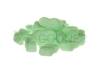
- Polystyrene loose fill – Expanded polystyrene, more than 99 % of whose volume is air. The bulk density is roughly between 3 and 4.5 kg/m³. The colour usually indicates the composition: green denotes recycled polystyrene, white mainly virgin material and pink an antistatic additive. Loose fill made from 100 % recycled polystyrene is also available on the market.
- Starch loose fill – Foamed plant starch, most often maize starch. It is water-soluble, does not build up static charge, and specific products often carry compostability certification to EN 13432. Compared with polystyrene it is roughly two to four times heavier, less resilient and can create dust.
The shape matters. Figure eights and S-shapes flow freely into every gap, and when compressed they interlock and hold the product in place. We offer loose fill in a standard version and in a BIO version. The material and documentation for the specific version will be stated in our quotation.
How to use loose fill
- Pour a layer of loose fill into the bottom of the box; at least 5 cm is recommended in the industry.
- Place the product in the centre so that a layer of fill of similar thickness separates it from all walls.
- Fill the space around and above the product up to the top of the box.
- Shake the box gently and top up. The contents must not shift when the box is moved.
- Separate several products in one box so that they do not knock against each other.
- Wrap products with sensitive surfaces or small openings in a bag or paper first, so that the loose fill does not get into them.
With higher consumption, loose fill is dispensed from a hopper (silo), so it does not have to be scooped out of the bag. Polystyrene loose fill has good shape memory and can be reused.
When loose fill is suitable
- Irregular shapes for which a shaped insert would be difficult to make.
- Several small items in one box.
- A changing product range, where every shipment is packed differently and the fill should not be prepared in advance.
- Manual packing without any machine.
- Reuse of fill, where loose fill from incoming shipments is used again for dispatch.
Loose fill is less suitable for heavy products, which gradually sink through the fill to the bottom of the box, and for flat and narrow items, which can turn and shift in free-flowing fill.
Points to watch
- Plastic loose fill is being phased out – Regulation (EU) 2025/40 on packaging (PPWR) adds polystyrene loose fill and other plastics used to protect goods during transport and handling to the plastic products that may not be placed on the market. This applies from 12 February 2029. Whether the ban also covers the starch version depends on its composition. For packing processes planned for the longer term, allow for a switch to a different fill.
- Empty space – Under the same regulation, grouped and transport packaging and e-commerce packaging may have no more than 50 % empty space, from 1 January 2030 at the earliest. Space filled with loose fill counts as empty space. Fill therefore does not solve the problem of an oversized box.
- Heavy products sink – Place a thicker layer or a sheet of corrugated board under the product, or choose a fixed insert.
- Static charge – Polystyrene builds up a charge and the pieces then cling to the product. For electronics, antistatic or starch loose fill is used.
- Starch loose fill and moisture – It dissolves in water, so it is stored dry and is not suitable for damp goods.
- Unpacking – Free-flowing fill spills easily when the box is opened.
Loose fill or another void fill
Crumpled paper is a paper void fill that the recipient puts into paper recycling together with the box. Air cushions are made right at the packing table from film on a roll, so no bulky material needs to be stored. Fragile items are often wrapped in bubble wrap before the loose fill is poured in. For gift packs, where appearance also matters, decorative SizzlePak is used. Heavy products and parts that must be held in an exact position need a custom insert, for example made of PE foam.
What to send with your enquiry
- Typical box dimensions, and the dimensions and weight of the goods
- Expected monthly consumption, or number of shipments
- Required material: polystyrene or starch loose fill
- Requirements for an antistatic version
- Filling method: manually from the bag, or from a hopper
Frequently asked questions
What is the difference between polystyrene and starch loose fill?
Polystyrene loose fill is lighter and more resilient, can be reused and is not affected by damp. Starch loose fill is heavier, dissolves in water and does not build up charge, so it is also suitable for electronics. It can be composted if the manufacturer provides certification.
How much loose fill will I use?
Consumption corresponds to the volume of empty space in the box. A 400 × 300 × 300 mm box has a volume of 36 litres. If the product takes up 10 litres, you will use about 26 litres of loose fill, so a 500-litre bag, the size in which loose fill is commonly sold, will be enough for about 19 such boxes.
Is loose fill suitable for heavy items?
Only to a limited extent. A heavy product gradually sinks through free-flowing fill to the bottom. A thicker bottom layer or a sheet of board under the product helps, but a custom insert is more reliable.
How should loose fill be stored?
Polystyrene loose fill is not damaged by moisture or ageing and can be stored practically indefinitely. It does take up space, however: a standard bag has a volume of 500 litres. Starch loose fill belongs in a dry store in closed packaging, because moisture softens it and makes it break down.
Where does used loose fill go?
Polystyrene loose fill can be reused; otherwise it goes into separate plastic collection. Starch loose fill is disposed of according to the manufacturer’s instructions, usually in organic waste or by dissolving it in water.