Bags
Bags are used for packaging, sales, and professional presentation of goods – ranging from simple HDPE t-shirt bags to luxury gift designs. We offer a wide range of gift and shopping bags in both paper and plastic options, allowing you to choose based on purpose, appearance, and budget. For larger orders, we also provide custom logo printing.
What types of bags we offer
- White and brown paper – basic bags for everyday packing and sale
- HDPE carrier bags – light, economical plastic bags for fast packing
- Coloured kraft – strong paper bags with an attractive look
- Luxury varnished gift bags – upmarket bags for premium and gift packaging


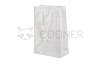


Paper bags
The size of a paper bag is given in the order width × gusset × height.
- Machine-made kraft paper bags – Kraft paper made from the long fibres of sulphate pulp has high tensile strength. Brown kraft is unbleached, white kraft is bleached. Shopping bags use a grammage of roughly 70–110 g/m². According to suppliers, these bags carry roughly 4–14 kg of evenly distributed contents, depending on the grammage, size and handle type.
- Flat handle – A strip of paper folded and glued to the inside of the top edge of the bag. The simplest version for machine-made bags.
- Twisted handle – A handle made of twisted paper cord, glued inside the bag.
- Gift bags – Made of coated, uncoated offset or designer paper with a grammage from about 200 g/m², large bags around 250 g/m². Coated paper can be laminated with a gloss or matt film, while uncoated offset paper is usually left without lamination. The bottom and the top fold are reinforced with board. Handles are made of polypropylene, polyester or cotton cord, or satin ribbon. The cord is finished with a knot or a clip, and some bags have metal eyelets.
Plastic bags
- HDPE – A thin, rustling film with high tensile strength even at low thickness. The typical version is the „T-shirt“ bag with handles cut out of the film. Once torn, however, the film tears further easily.
- LDPE – A softer, more flexible film produced in a thicker gauge. The bags have a die-cut handle, i.e. a punched hand hole, or a welded loop handle.
Our plastic bags include HDPE T-shirt bags with a thickness of 20 µm and LDPE die-cut handle bags with a thickness of 45 µm. Our paper bags include white and brown bags, coloured kraft bags and luxury gift bags, and for bottles also wine bags.
Printing and finishing
- Flexographic printing is used on machine-made kraft paper bags and on plastic bags.
- Offset printing gives full-colour print with fine detail and is used mainly on gift bags.
- Screen printing and digital printing are further options for printing paper bags.
- Hot foil stamping, blind embossing and spot varnish highlight a logo or part of it.
The extent of the print is given as the number of colours on the front and back, for example 4/0 for full-colour print on one side and 4/4 for both sides. For larger orders we can arrange printing with your own logo.
Choosing a bag
- Weight and shape of the contents – These determine the paper grammage or film thickness, the gusset width and the handle type.
- Number of uses – A machine-made bag is enough for carrying a purchase once; for repeated use and presenting a gift, a gift bag with a reinforced bottom and cord handles is chosen.
- Appearance – Natural kraft paper, white paper, coloured paper, or a laminated surface with foil stamping.
- Sorting by the recipient – If the bag is meant to end up in paper recycling, choose paper without lamination and paper handles.
Points to watch
- Load capacity applies to evenly distributed contents – The supplier’s figure is no guarantee for heavy items with sharp edges.
- Lamination – A glossy bag surface usually means plastic lamination. Such a bag does not belong in paper recycling.
- Plastic carrier bags in shops – In the Czech Republic, under the Packaging Act, shops have not been allowed to give customers plastic carrier bags free of charge since 2018. The exception is thin bags under 15 µm with a hygiene function, for example for bread or vegetables. In addition, the PPWR requires member states to reduce the consumption of lightweight plastic carrier bags thinner than 50 µm.
- Environmental claims on the bag – From 27 September 2026, Directive (EU) 2024/825 prohibits generic claims such as „eco-friendly“ or „kind to nature“ unless the trader can substantiate them with recognised excellent environmental performance, for example the EU Ecolabel. This also applies to wording printed on the bag.
A bag or other packaging
For shipping goods, bags and pouches and envelopes are used instead of carrier bags. Wine is handed over in bottle bags, while wine packaging with inserts is used for transport. Where the gift also needs a rigid pack, a gift box is chosen and the bag complements it when the gift is handed over.
What to send with your enquiry
- Material: kraft paper, coated paper, HDPE or LDPE
- Size (width × gusset × height) and the expected weight of the contents
- Handle type: flat, twisted, cord, ribbon, die-cut
- Bag colour and print (number of colours, one or both sides), artwork
- Finish: lamination, foil stamping, varnish
- Quantity and order frequency
Frequently asked questions
What is the difference between a flat and a twisted handle?
A flat handle is a strip of paper glued to the inside of the bag’s edge; a twisted handle is a twisted paper cord. Both are used on machine-made kraft paper bags. According to suppliers, bags with twisted handles have a load capacity of roughly 6–12 kg.
What does width × gusset × height mean?
Width is the dimension of the front, the gusset is the depth of the bag, i.e. the width of the folded side, and the height is measured from the bottom to the top edge.
Why is an HDPE bag thinner than an LDPE bag?
HDPE has higher tensile strength, so a thinner film is sufficient. LDPE is softer and more flexible, but needs a thicker film for similar strength.
Where does a used bag go?
A paper bag without lamination goes into paper recycling; twisted paper handles can stay on. Cords, ribbons and metal eyelets need to be removed. Laminated bags belong in mixed waste, clean plastic bags in plastics recycling.