Thermal transfer ribbons (TTR)
TTR ribbons (thermal transfer ribbons) ensure printing in thermal transfer label printers – during the printing process, the ink from the ribbon is transferred onto the label by heat, creating a sharp, durable, and smudge-resistant print. We offer a wide range of thermal transfer ribbons in various widths, roll lengths, and core types, suitable for all standard types of printheads.
What types of TTR ribbons we offer
- Various widths and roll lengths – ribbons for various printers and print volumes
- Various core types – compatible with common label printer models
- For all common print heads – flat head and near-edge versions
- Durable, sharp print – scuff-resistant, ideal for warehouse and logistics labels



How a ribbon is built
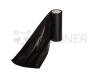
- Base film – Thin polyester (PET), which gives the ribbon strength and dimensional stability.
- Ink layer – Wax, wax-resin or resin. Between the ink and the base film there is usually a release layer, which lets the ink separate cleanly from the film so the print does not smudge.
- Backcoat – It faces the print head. It is heat-resistant, protects the head from abrasion and limits static build-up.
Wax, wax-resin, resin
- Wax – Prints well even at a low print head temperature. However, the print has poor resistance to abrasion, solvents and high temperatures. It is mainly suited to paper labels.
- Wax-resin – A combination of both components, with a more durable print than wax. It is the universal choice for most label materials.
- Resin – The print is highly resistant to external influences such as abrasion, chemicals and heat. It is used on plastic and textile labels in demanding conditions. It prints more slowly and at a higher print head temperature.
Flat head and near-edge
Ribbons also differ according to the type of print head.
- Flat head – The heating elements are in the middle of a flat print head, and the ribbon stays in contact with the label beyond the print point. The ink has time to transfer. Most label printers have this type of head.
- Near-edge – The head is tilted at about 45° and the heating elements are on its edge. The ribbon separates from the printed material immediately after the print point, so the ink must release instantly. Near-edge ribbons therefore have a special release layer and are made only in wax-resin and resin. They are used mainly in thermal transfer overprinters (TTO) on packaging lines, which print the date, batch or barcode directly onto packaging film.
Ribbons for flat heads and for near-edge heads are not interchangeable. We supply TTR ribbons for both types of head, in various widths and lengths and with various cores.
Dimensions and winding
- Width – Ribbons are made from about 33 to 220 mm wide. The ribbon must be as wide as the label or wider. Otherwise, the part of the head not covered by the ribbon wears out prematurely.
- Length – From 74 m to about 1,000 m, depending on the roll size the printer can take.
- Core – Most printers use a 25.4 mm (1″) core, some a 12.7 mm (0.5″) core.
- Ink side out (OUT) or in (IN) – This is determined by the printer. The ink side is easy to check: press the sticky side of a label onto the outer side of the ribbon and pull it off. If ink remains on the label, the ribbon is wound ink side out.
Choosing the right ribbon
- Label material – Wax for paper, wax-resin for coated paper and standard films, resin for polypropylene, polyester and textiles.
- Print durability – Abrasion during handling, chemicals, high temperatures or outdoor use point to resin.
- Printer – Head type, maximum ribbon width and length, core diameter and winding direction.
Points to watch
- Thermal labels do not need a ribbon – They are printed by direct thermal printing. Using a ribbon can distort the print, and barcodes may then be unreadable.
- A narrow ribbon damages the head – A ribbon narrower than the label leaves part of the head unprotected.
- Resin needs different settings – It is printed at a higher head temperature and a lower speed than wax.
- Mixing up head types – A flat-head ribbon does not print correctly in a near-edge printer, and vice versa.
Related products
Ribbons are used to print self-adhesive labels, whether logistic labels on corrugated boxes or labels on bags of small parts.
What to send with your enquiry
- Printer make and model, or the head type (flat head, near-edge)
- Width of the label or of the printed film web
- Label material (paper, coated paper, polypropylene, polyester, textile)
- Required print durability (abrasion, chemicals, temperature, outdoor use)
- Ribbon length, core diameter and winding direction (IN or OUT), if known
- Monthly roll consumption
Frequently asked questions
Do I need a TTR ribbon for thermal labels as well?
No. Thermal labels have a sensitive coating that darkens directly under the print head. A ribbon is only needed for thermal transfer labels.
Which ribbon should be used for paper labels?
A wax ribbon is sufficient for standard paper labels. If the labels get scuffed during handling, choose wax-resin.
How do I find out whether the printer needs IN or OUT winding?
This is stated in the printer manual. For a ribbon already in the printer, the test with the sticky side of a label described above will help.
Why does the print rub off?
Most often because the ribbon does not match the label material or the operating conditions. Wax print has low abrasion resistance. Films and demanding environments require wax-resin or resin.