Custom cardboard boxes
Cardboard boxes are a basic packaging option for transport, storage and dispatch of goods. We offer a wide range of boxes and dividers made of corrugated board in various sizes and strengths, from simple slotted boxes to shaped die-cut packaging. Whatever we don’t have in stock, we’ll make to your specification – tailored exactly to the product being packed.
What cardboard boxes we offer
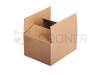
- Slotted boxes – classic shipping boxes for everyday packing and dispatch
- Die-cut boxes – custom-shaped packaging for secure fixing and presentation of the product
- Book boxes – packaging with edge protection, ideal for shipments of books and printed matter
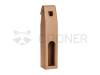
- Wine boxes – shipping and gift boxes for one or more bottles




How corrugated board is built up
The board consists of flat liners with fluted layers between them, bonded with starch adhesive. By the number of plies, a distinction is made between:
- Single wall (3-ply) – One fluted layer between two liners. Standard shipping and e-commerce boxes.
- Double wall (5-ply) – Two fluted and three flat layers, often combining two different flutes, for example BC. For heavier contents, higher stacks and longer transport.
- Triple wall (7-ply) – Three fluted layers, for large and heavy industrial packaging.
Flutes are designated by letters according to their height. C flute is 3.1–4.0 mm high, B flute 2.2–3.1 mm and E flute, known as microflute, 1.0–1.9 mm. The coarse A flute, 4–5 mm high, is used less often today. A higher flute gives a thicker and stiffer wall, a lower flute a smoother surface for print and more precise die-cutting.
The liners are either kraftliner, made mainly from virgin fibre, or testliner made from recycled fibre. The fluted layer is usually wellenstoff made from recovered paper, or fluting with a share of virgin fibre.
According to the manufacturer’s technical data sheets, the boxes we supply are made from 3- to 5-ply board with E, B, C and R flutes (R being the manufacturer’s flute, lower than B) and their combinations. The liners are testliner, in some grades kraftliner, and the outer layer is either brown or white.
Construction according to the FEFCO code
Box constructions are described by the international FEFCO-ESBO code. The four-digit code defines the shape of the blank and the method of assembly; the first two digits give the group:
- 01 – sheets and rolls – Flat sheets and board on the roll.
- 02 – slotted boxes – One piece with a joint on the side and flaps at the top and bottom. The most common is 0201, where the outer flaps meet in the middle.
- 03 – telescope boxes – A base and a slip-on lid.
- 04 – folder boxes and trays – Die-cut from a single blank, delivered flat and assembled without glue using locks. Typical e-commerce boxes belong here.
- 07 – ready-glued cases – The bottom is glued at the factory, so the box is erected in one movement.
- 09 – interior fitments – Dividers, partitions, grids and inserts.
Box size is given as the internal dimensions in millimetres in the order length × width × height. A slotted box can be given an additional crease line, along which the flaps are folded lower so that the box is reduced to the height of its contents. We supply slotted boxes and sheets both unprinted and printed.
Printing
- Flexographic printing – Relief printing directly onto corrugated board with water-based inks. Suitable for shipping and group packaging with simpler graphics. This is also how the printed boxes we supply are produced.
- Offset with lamination – Full-colour, fine-screen printing on a sheet of paper or board, which is then laminated onto corrugated board. Used for retail and gift packaging; see lamination for details.
- Digital printing – Needs no printing plate, so it is also used for short runs and for packaging with variable designs.
Strength: ECT and BCT
- ECT (Edge Crush Test, ISO 3037) states in kN/m the force the board withstands when compressed on its edge. It describes the material.
- BCT (Box Compression Test, ISO 12048) states in newtons the force the whole closed box will carry before it collapses. It depends on the ECT, the board thickness and the box perimeter. It is estimated with the McKee formula; only a test determines it reliably.
The laboratory value applies to a new box, short-term loading, 23 °C and 50 % relative humidity. In a warehouse, a safety margin is needed:
- Duration of load – Strength decreases gradually under sustained load. For a stack to last about 100 days, the load should not exceed about 55 % of the measured BCT.
- Humidity – When relative humidity rises from 40 to 90 %, a box loses around half of its stacking strength.
- Pallet overhang – The load is carried mainly by the corners and vertical walls. If boxes overhang the pallet edge by 25 mm on one side, stacking strength drops by 14–34 %.
- Stacking pattern – Strength is used best when the boxes stand exactly on top of each other. An interlocking pattern improves pallet stability but reduces stacking strength.
Points to watch
- Size to fit the contents – An oversized box needs more void fill and takes up more space in transport. In addition, the PPWR will limit empty space in grouped, transport and e-commerce packaging to a maximum of 50 %, from 1 January 2030 at the earliest. The obligation lies with whoever fills the packaging, and void fill – paper, air cushions, bubble wrap or foam – counts as empty space.
- Storage – The manufacturer of the boxes we supply specifies a dry, ventilated and covered warehouse free of odours and direct sunlight, a temperature of 10–30 °C and relative humidity of 25–65 %.
A box or other packaging
Where the packaging also needs to make an impression, gift boxes are chosen. For bottles there is wine packaging; for repeated in-house transport, corrugated plastic and crates and boxes. Goods inside the box are held by air cushions, crumpled paper or moulded pulp parts, and layers on a pallet are separated by paper layer pads.
What to send with your enquiry
- Internal box dimensions (length × width × height), or the dimensions and weight of the goods
- Construction: the FEFCO code if you know it, otherwise a sample or a description of how the box is filled
- Weight of the contents, stack height and storage time
- Environment: humid or chilled warehouse, export, direct food contact
- Board grade if specified (single or double wall, flute) and the colour of the outer layer
- Printing: number of colours and artwork
- Quantity per order and expected annual consumption
Frequently asked questions
How should I specify the box size?
As internal dimensions in millimetres in the order length × width × height. The external dimensions are larger by the thickness of the board. This matters for boxes that are stacked on a pallet or placed inside other packaging.
Are the boxes suitable for food?
The standard boxes we supply are not intended for direct contact with food. With goods in their own packaging, such as bottles or packaged food, the box does not come into contact with the food. If food is to lie in the box unpackaged, please state this in your enquiry.
What fibres are the boxes made from?
The boxes we supply come from two groups of board. The first is made entirely from recycled fibre. The second combines recycled and virgin fibre, with recycled fibre making up 31–87 % depending on the grade.
Where does a used box go?
Into paper recycling, ideally flattened. Adhesive tape does not need to be removed, as it separates from the paper during recycling. Boxes contaminated with grease, paint or chemicals do not belong in paper recycling.