Plastic packaging
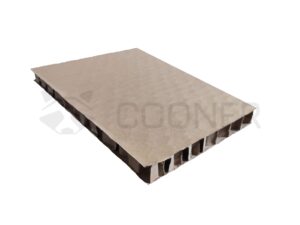
Plastic corrugation (corrugated plastic) is an interesting alternative to standard cardboard thanks to its properties, especially where packaging is returnable and used repeatedly. The hollow polypropylene board is lightweight, strong, resistant to moisture and chemicals, and can withstand many more cycles than paperboard. We manufacture custom boxes, dividers, and layer pads from it according to customer requirements.
What we manufacture from corrugated plastic
- Boxes and transport packaging – returnable, reusable boxes resistant to moisture
- Grids and dividers – separation and fixing of individual pieces inside the pack
- Layer pads – separation and protection of layers of goods in transport and storage
- Durability and reuse – a waterproof, durable replacement for cardboard in multi-trip packaging




Material
The sheets are made by extruding polypropylene. Parallel flutes form between two smooth walls, giving the sheet rigidity at low weight. Sheets are produced in thicknesses of 2–10 mm and grammages of roughly 250–3,000 g/m²; the most common thicknesses are 3, 4 and 5 mm. A thicker, heavier sheet is stiffer and carries more.
Polypropylene is chemically inert and, at normal temperatures, resists water, oils and solvents. It also resists mould. The sheet is produced in clear, white, black, grey and other colours. Treatments are chosen according to the application:
- Antistatic and conductive (ESD) versions – reduce the build-up of electrostatic charge; conductive sheets protect electronics and discharge-sensitive components.
- UV stabilisation for outdoor use.
- Flame-retardant additive where flammability is a concern.
- Food-contact grade.
- Corona treatment before printing, so that the ink adheres to the surface.
Products made from corrugated plastic
We make boxes and returnable containers, inserts with dividers, partition grids and layer pads to measure, including printed versions and versions with closures.
- Boxes and returnable containers – The blank is die-cut and creased much like cardboard and joined by welding, rivets or staples. The box can be closed with flaps or a clasp.
- Inserts with dividers and partition grids – These separate individual items inside the pack so that they do not rub against each other or shift.
- Layer pads – These separate layers of goods on a pallet. Unlike paper layer pads, they can be washed and reused.
Processing
- Die-cutting and creasing – The shape is cut with a cutting die and the folds are creased. No injection mould is needed, as it would be for plastic crates, so the pack can be made to the exact size of the product.
- Joining – Ultrasonic or heat welding, riveting, stapling, gluing.
- Edge sealing – The open flutes along the edges are sealed. Dust, water and oil cannot then get inside, and the pack is easier to clean, which matters wherever hygiene is a concern.
- Printing – Screen printing or digital printing on a corona-treated surface.
Points to watch
- Treatments have a limited lifetime – Sheet manufacturers state that corona treatment for printing lasts around 3 months, antistatic treatment around 6 months, and UV stabilisation 18–48 months depending on the type. For permanent protection of electronics, the conductive version is therefore chosen.
- Open flutes trap dirt and water. For packs that are washed, choose sealed edges.
- Freezing temperatures – Polypropylene becomes brittle below freezing and can crack on impact.
- Metal parts – Rivets and metal clasps need to be removed before recycling.
Corrugated plastic or other packaging
For one-way trips with no return, corrugated cardboard boxes are normally used. For standard sizes and more demanding use, injection-moulded crates and boxes serve as rigid returnable packaging; corrugated plastic is lighter and can be made to any size. Sensitive parts inside the pack are held by foam cut-outs made from PE foam or by blisters. Layer pads between layers on a pallet can also be made from paper – see cardboard edge protectors and layer pads.
What to send with your enquiry
- Product dimensions and weight, number of items per pack
- Type of pack: box, insert with dividers, partition grid, layer pad
- How the pack circulates: number of trips, washing, stacking, handling
- Required treatments: ESD, UV, food contact, flame retardancy
- Closures, printing, sealed edges
- Quantity and expected annual consumption
- A sample of the product or the existing pack, or a drawing
Frequently asked questions
How many trips does corrugated plastic last?
There is no general figure. It depends on the thickness and grammage of the sheet, the weight of the contents, handling and washing. Unlike cardboard, however, it does not lose strength in humid conditions, which is why it is used for packaging that returns.
Can corrugated plastic be washed?
Yes. It withstands water and common cleaning agents. Boxes with sealed edges are easier to clean, because dirt cannot get into the flutes.
Is it suitable for electronics?
The conductive (ESD) version is used for electronics. The antistatic treatment of a standard sheet weakens over time and is not sufficient for permanent protection of discharge-sensitive components.
Is corrugated plastic recyclable?
The sheet is made of polypropylene (code 5, PP) and can be recycled. Metal parts such as rivets and clasps need to be removed first.