Adhesive tapes
Adhesive tapes are part of the basic equipment of every packing station – they’re used for sealing boxes, fixing, and marking shipments. We offer a complete range of adhesive tapes in both plastic and paper versions, in various widths, lengths and with different types of adhesive depending on how demanding the application is. We’ll help you choose a tape that holds reliably and suits your operation and type of cardboard.
What adhesive tapes we offer
- Plastic and paper – from standard packing tapes to paper tapes for mono-material recyclable packaging
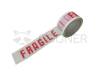
- Printing option – tapes with your company logo or a message (e.g. “Fragile”, “Glass”)
- Various widths and roll lengths – to suit packing volume and box size
- Various adhesives – acrylic, low-noise acrylic, hot-melt and solvent, depending on temperature, surface and tack requirements


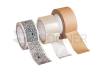


Backing
- Polypropylene (BOPP) – Biaxially oriented polypropylene film is the most widely used backing for packaging tapes, usually 25–32 µm thick. It is strong and light.
- PVC – A backing of roughly 28–37 µm is more flexible and more tear-resistant than polypropylene and unwinds evenly and quietly. It usually carries a natural rubber adhesive. The two are easy to tell apart: pierced polypropylene tape tears, PVC tape only gets a hole and turns milky when stretched.
- Paper – A kraft paper backing with a self-adhesive coating, usually rubber or hot-melt. A different type is gummed paper tape, whose adhesive is activated by water and bonds with the surface of the board. Gummed tape is also made reinforced with glass fibre.
Adhesive
- Acrylic – Made from a water-based dispersion, without solvents. It resists UV light and ageing well and stays clear. However, it only reaches full adhesion after several hours and is not suited to cold conditions. It is noisy when unwinding.
- Low-noise acrylic – A modified acrylic that unwinds considerably more quietly than standard acrylic.
- Hot-melt – A synthetic rubber-based adhesive, without solvents. It grabs instantly and holds well on corrugated board. It is less resistant to UV light.
- Solvent – Natural rubber with resin. It bonds quickly and strongly to most surfaces, including slightly soiled ones. It holds over a wide temperature range, from −30 to +70 °C according to one manufacturer, which is why it is used in cold stores and freezers. It unwinds quietly but leaves adhesive residue when removed.
We supply polypropylene tapes with acrylic, low-noise acrylic, hot-melt and solvent adhesive, as well as a freezer-grade version. We also supply PVC tape with solvent adhesive and paper tapes. Clear tapes come in widths from 48 to 75 mm and lengths of 50–132 m. We can print tapes with your logo or text.
Width, length and machine rolls
- Hand rolls – The most common widths are 48 and 50 mm with a length of around 66 m on a 76 mm inner-diameter core, which fits standard hand dispensers.
- Wider tape – Widths of 72 and 75 mm are chosen for larger and heavier boxes.
- Machine rolls – Rolls of around 990 m are supplied for semi-automatic and automatic case sealers. Width, core and adhesive must match the machine.
Printing
Tapes are printed by flexography. Polypropylene, PVC and paper can all be printed. A printed tape carries a logo, a handling instruction such as „Fragile“ or a thank-you to the customer. Artwork is supplied as vector files (for example AI, EPS, CDR or PDF). The colour can be specified from the Pantone guide. The same colour, however, looks different on a white box and on a brown one, which is worth taking into account at the design stage.
Choosing the right tape
- Box weight – Light and medium-weight shipments are sealed with 48–50 mm polypropylene tape. Heavier boxes call for wider tape or PVC.
- Temperature – Cold stores, freezers and unheated warehouses need a solvent adhesive or a freezer-grade tape. Acrylic tolerates heat and UV light.
- Board – Recycled and dusty board needs an adhesive with high initial tack, i.e. hot-melt or solvent.
- Workplace – Where noise is a problem, low-noise acrylic, PVC or solvent tape is suitable.
- Application method – Hand dispenser or case sealer.
- Single-material packaging – If the customer requires all-paper packaging, paper tape is chosen. Even here, though, the adhesive is a different material from paper.
Points to watch
- Acrylic needs time – It only reaches full adhesion after several hours. Boxes that go straight into the cold should be sealed with a rubber-based adhesive tape.
- Application temperature – Most tapes should be applied at roughly 15–25 °C, even if they then withstand lower temperatures. Store the rolls in a temperature-controlled area.
- Pressure – A pressure-sensitive adhesive only forms a bond once it is pressed down. After applying the tape, run a hand or the dispenser’s wiper over it.
- Overfilled box – The flaps push outwards and the tape ends on the box ends gradually creep. They are held by the adhesive’s shear strength, but a correctly sized box helps most.
- Reinforced paper tape – Glass fibres do not break down during paper recycling and have to be separated out.
Related products
Tapes seal, for example, corrugated boxes or wine packaging. Shipments are also marked with labels, and pallet loads are secured with stretch film. Goods inside the box are held in place by air cushions or crumpled paper.
What to send with your enquiry
- Size and weight of the boxes, type of board (recycled, white, brown)
- Hand or machine application; for a machine, the type of case sealer, roll width and inner core diameter
- Temperature during packing, storage and transport
- Required backing and adhesive, or the tape you currently use and want to replace
- For printing, the text or logo as vector files, number of colours and tape colour
- Monthly roll consumption
Frequently asked questions
What is the difference between acrylic, hot-melt and solvent tape?
Acrylic is clear, light-stable and tolerates heat, but only reaches full adhesion after several hours. Hot-melt grabs instantly and suits recycled board. Solvent natural rubber tape bonds quickly, holds even in freezing conditions and unwinds quietly.
Which tape withstands freezing temperatures?
Tape with a solvent natural rubber adhesive, or the freezer-grade version. The box should, however, still be sealed at room temperature.
Why is tape noisy when unwinding?
The noise is created as the adhesive is pulled away from the back of the previous layer. Low-noise tapes have a modified adhesive or release coating. PVC tapes and solvent adhesive tapes are also quieter.
Does the tape have to be removed before the box is thrown away?
No. A box with tape on it goes into paper collection, and the tape is separated from the paper during recycling.
Can you print the tape with our logo?
Yes. Send us the logo or text as vector files, the required tape and print colours and your estimated consumption. We will prepare a price based on your specifications.