
Studies by public bodies in England, Denmark and the USA reach the same rule: for bags and carrier bags, weight decides. The lightest plastic bag comes out best until a paper bag is used many times. The paper industry and the plastics industry publish studies with opposite headlines. The difference arises mainly from what the assessment counts, for example pollution of nature by plastics. Below you can see who paid for each study, what it measured and what follows from it.
Who paid for the studies
| Source | What it is | Commissioned by | What to watch for |
|---|---|---|---|
| Environment Agency (England, 2011), report SC030148 | life cycle assessment of seven kinds of supermarket carrier bags (HDPE, LDPE, paper, non-woven PP, cotton and others) | the Environment Agency itself, which commissioned and funded the report | does not include littering or a carrier bag tax |
| Danish Environmental Protection Agency (2018), project no. 1985, prepared by DTU | life cycle assessment of bags made of LDPE, PP, PET, polyester, biopolymer, paper, textile and composite | the Danish agency (Miljøstyrelsen); critical review under ISO 14040/14044 (COWI) | littering was not included in the calculation because it was considered negligible for Denmark |
| Oregon DEQ / US EPA (2004) | inventory of energy, waste and emissions for boxes with void fills and mailing bags | public bodies Oregon DEQ and Metro; US EPA contributed to the review | American data from 2003, inventory only; the authors warn against generalising to “paper versus plastic” |
| NCASI (2020), review of studies | a review of studies comparing paper and plastic products | NCASI is a research organisation of the forest products and paper industry | the review mainly points out what the studies leave out |
| Tacker et al. (2025), Cleaner Environmental Systems | assessment of polyethylene packaging and its alternatives in Europe (37 products, five application areas, from stretch films to heavy-duty sacks) | funded by ExxonMobil; three authors work for the company | measures climate, water scarcity and fossil resources; does not cover mailing bags or void fill |
Three sources come from public bodies. Two (NCASI and ExxonMobil) come from industry. We treat those as claims of an interested party and state who paid for them.
Weight decides: the lightest bag comes out best
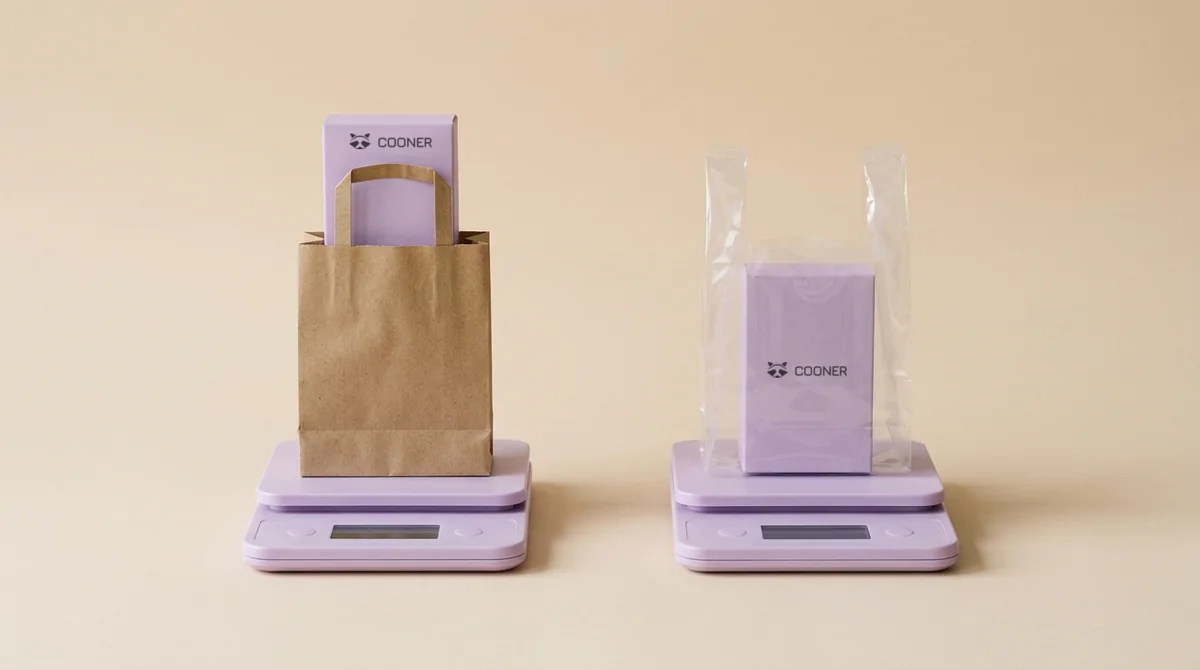
The British report weighed seven kinds of bags. A conventional HDPE bag weighs 8.12 g, a paper bag 55.20 g, which is about 6.8 times more. The report states that the HDPE bag had the lowest impact in eight of nine categories because it was the lightest bag. For the paper bag, extraction of raw material and production make up over 70 % of the impact in each of the eight categories.
The Oregon study reached the same conclusion: the weight of the packaging matters most, because the burden from production, transport and waste grows with weight (details in the article Paper or air cushions?). The Danish report states that LDPE bags have the lowest impacts in shops for most indicators. Unbleached paper bags and biopolymer bags have similarly good results for fewer indicators. Heavier bags (PP, PET, polyester, bleached paper, textile) must be used many times for their production to balance the impact.
How many times a bag must be used
Both reports calculate how many times a bag must be used for shopping so that its impact falls below the impact of a thin plastic bag. The numbers are minimums and depend on what happens to the plastic bag. If the plastic bag is reused (for example as a bin liner), the number required for the other bags grows.
| Report | Paper bag | Note |
|---|---|---|
| England (2011), climate impact | 3×; 4× (40 % of HDPE bags reused); 7× (all HDPE bags reused); 9× (HDPE bag used three times) | comparison with the HDPE bag; according to the report a paper bag is not reused as a bin liner |
| Denmark (2018), climate impact | unbleached: can be used directly as a bin bag; bleached: at least 1× | comparison with the LDPE bag |
| Denmark (2018), all indicators | at least 43× (unbleached and bleached) | the number is the highest of the values for the individual categories |
It follows that a paper bag needs a few uses for the climate impact, but much more for all categories together (up to 43). The number of uses depends on how long the bag lasts and how it is processed afterwards.
What studies from industry claim
The paper industry: the NCASI review (2020) states that studies are often used to conclude that lightweight plastic bags come out better than paper bags. At the same time it points out that this conclusion depends on many factors and that, with a few exceptions, studies do not include pollution of nature. The few studies that did include it showed a clear advantage for paper. The British and Danish reports do not include it in the calculation (see the table).
The plastics industry: the study by Tacker et al. (2025) was funded by ExxonMobil. Polyethylene had the lower climate impact in 34 of 50 comparisons. In 13 comparisons the alternative was better and in 3 the difference was under 10 %. According to the authors, replacing PE with alternatives would increase the weight of packaging by 244 % to 306 %. So even this study shows cases where paper is better, and again it stresses weight.
What follows from this
- Weight is the common denominator. Studies by public bodies in England, Denmark and the USA agree: a light packaging comes out better, and a heavier material must make up for its weight by repeated use.
- A paper bag needs extra uses. For the climate impact a few uses are enough, for all categories together up to 43 according to the Danish report.
- Headlines from industry differ because of what is counted. The paper industry points to pollution of nature, the plastics industry to weight and climate. Life cycle assessments mostly do not include pollution of nature yet.
- A single-use bag and a reusable carrier bag are two different questions. These studies compare shopping bags. Mailing bags and void fill are described in the article Paper or air cushions?.
- What is missing: an independent study that would directly compare single-use paper and plastic mailing bags in Czech conditions.
Sources
- Edwards, C., Meyhoff Fry, J.: Life Cycle Assessment of Supermarket Carrier Bags. Environment Agency, report SC030148, 2011 (tables of weights and number of uses, Chapters 5, 6 and 8).
- Bisinella, V., Albizzati, P. F., Astrup, T. F., Damgaard, A.: Life Cycle Assessment of grocery carrier bags. Danish Environmental Protection Agency, Environmental Project no. 1985, 2018 (summary, Tables III and IV).
- Franklin Associates (ERG) for Oregon DEQ, Metro and US EPA: Life Cycle Inventory of Packaging Options for Shipment of Retail Mail-Order Soft Goods, April 2004.
- NCASI: Review of life cycle assessments comparing paper and plastic products, White Paper WP-20-09, 2020.
- Tacker, M., Hafner-Kuhn, T., Gstöhl, A., Nduagu, E. I., Vozzola, E., Roux, T. W., Auras, R. A.: Life cycle assessment of polyethylene packaging and alternatives on the European market. Cleaner Environmental Systems, 2025. doi.org/10.1016/j.cesys.2025.100270.
Would you like to know the right solution for your goods? Write to us the type of goods, the weight and how you ship them.
