Cardboard laminating
Lamination (mounting) is a technology in which two materials are glued together to create a strong, multi-layer unit with better properties than each layer has individually. Most commonly, a visual top layer (printed paper) is laminated onto a strong carrier material, creating a product that is both representative and durable. Applications range from packaging and cardboard products to die-cut and structural parts.
What you gain from lamination
- Better abrasion resistance – a coated surface resists abrasion and damage better
- Premium appearance – a printed face layer on a rigid base
- Higher strength and stiffness – bonding the layers creates a more durable material
- Custom combinations – surface and carrier material chosen for the purpose and the customer’s requirements




Material combinations
- Printed sheet on corrugated board – Offset-printed paper or board is laminated onto single-face corrugated board, most often with a low E, F or B flute. The packaging has offset print quality combined with the strength of corrugated board. It is used for retail and gift packaging, displays and wine packaging.
- Paper on greyboard – The wrap of rigid gift boxes.
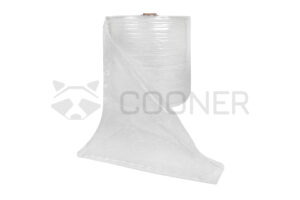
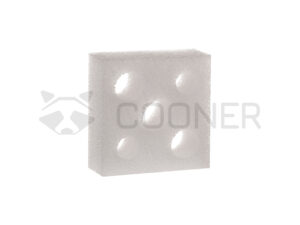
- PE foam on board – A soft foam layer protects the surface of the product and absorbs shocks. Suitable for layer pads, bases and retention parts.
- Non-woven textile on board – A soft surface that does not scratch. It protects painted and visible parts, for example in the automotive industry during transport and on assembly lines.
- Film on board – Polyethylene or aluminium foil creates a moisture-resistant layer.
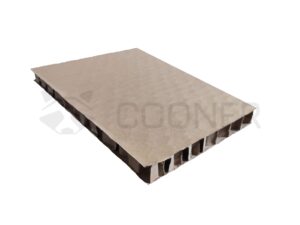
- Board on board or on honeycomb – Multi-layer panels for rigid layer pads and structural parts; see paper honeycomb.
We provide lamination of board with PE foam and non-woven textile, lamination of a printed visible layer onto a load-bearing material, and surface lamination of paper honeycomb panels.
Bonding methods
- Starch adhesive – Used mainly for bonding paper to paper and board, typically when laminating printed sheets.
- Dispersion adhesive (PVAc) – Applied cold, like starch adhesive.
- Hot-melt adhesive – Applied hot and sets on cooling, so the bond is complete immediately.
- Heat bonding – Thermoplastic materials such as films and foams are bonded by melting their surface with heat, without adhesive.
The choice of bond depends on the materials, the required bond strength and the temperature and humidity the part will be exposed to.
Lamination or direct print
With direct flexographic printing on corrugated board, the flutes can show through the surface and appear as stripes in the print. A laminated sheet is smooth, because it is printed separately and only glued to the board once printed. Laminated packaging can be further finished with spot varnish, foil stamping or blind embossing. Production, however, involves more steps – printing the sheet, laminating and die-cutting – so direct print is chosen where simpler graphics are sufficient. More on box printing on the cardboard boxes page.
Points to watch
- Board warp – Layers with different moisture content and fibre direction expand differently when humidity changes, and the panel warps. Balanced moisture in the materials, the smallest possible amount of adhesive and matched fibre direction help. Store laminated parts at a stable temperature and humidity.
- Creasing and bubbles – Laminated print can crack on crease lines, and bubbles can form between the layers. This is prevented through the choice of materials and adhesive and the setting of the creases.
- Sorting and PPWR – Paper laminated onto board remains paper packaging; adhesives and inks are not counted as a separate material. Board with foam, textile or film that cannot be separated by hand is composite packaging under the PPWR if the second material makes up more than 5 % of the weight. If the packaging is to end up in paper recycling, choose a paper-on-paper combination.
Lamination or another solution
Where a soft insert without a board backing is sufficient, PE foam cut-outs are used. For returnable packaging used repeatedly to transport parts, corrugated plastic is used. Full-colour packaging for individual products is covered by gift boxes and wine packaging.
What to send with your enquiry
- Load-bearing material: corrugated board (number of plies and flute), greyboard or honeycomb
- Surface layer and its purpose: print, cushioning, surface protection, moisture barrier
- Size of the sheet or finished part; for die-cut parts, a drawing
- For printed work, artwork and the required finish
- Environment: humidity, temperature, repeated use
- Sorting requirements
- Expected quantity
Frequently asked questions
What is the difference between laminating onto board and film lamination?
Laminating onto board bonds two or more layers together, for example printed paper with board or board with foam. Film lamination means covering the print with a thin plastic film that protects it from abrasion. Board-laminated packaging can also be film-laminated.
Which corrugated board is used for laminating printed sheets?
Most often single-face corrugated board with a low E, F or B flute. The printed sheet forms one of the liners. A lower flute shows through the surface less, a higher flute gives a stronger wall.
Why is non-woven textile laminated onto board?
The textile is soft and does not scratch painted and visible surfaces. The board gives the part its shape and rigidity, while the textile protects the surface of the product it touches.
Can a finished die-cut part be laminated?
Usually not. The whole sheet is laminated, and die-cutting and creasing follow once the layers are bonded. The cutting drawing therefore has to allow for the thickness of all layers, and the shape of the part needs to be known in advance.