Bubble wrap
Bubble wrap is a versatile protective material with air bubbles that absorb shocks and protect goods from damage during handling and transport. It is lightweight, flexible, and easily adapts to the shape of the packaged item, making it suitable for wrapping, box lining, and interleaving. It is one of the most affordable and widely used packaging materials ever.
What bubble wrap is suitable for
- Wrapping goods – protects fragile and delicate items from impacts and scratches
- Void fill and box lining – fills empty space and holds the contents in place in transit
- Rolls and bags – available on rolls for your own packing and as ready-made bubble bags
- Light and economical – low weight does not add to shipping costs
- paper alternative – wrap paper




How the film is made
The base material is low-density polyethylene (LDPE). A thin film is extruded from pellets and, while still warm, is drawn by vacuum into the recesses of a rotating drum, where it is formed into bubbles. A second, flat film is immediately sealed to it, trapping the air in each bubble separately. The three-layer version has one more flat film on the bubble side, so the bubbles are covered on both sides.
The most common bubble is about 10 mm in diameter and roughly 4 mm high. For heavier and bulky items, a bubble of about 30 mm in diameter is made, and some manufacturers also offer an intermediate size of 15–16 mm. The film thickness of standard types is roughly between 35 and 70 µm; special films tend to be thicker. Rolls are made in widths from 20 cm up to 1.5–2 m.
Types
- Two-layer film – A layer with bubbles and one flat film; the bubbles are exposed on one side. The most widespread type for light and medium-weight goods and shorter transport.
- Three-layer film – The bubbles are enclosed between two flat films. It is harder to puncture, smooth on both sides and suits heavier items, longer transport and storage.
- Film with a barrier layer – An intermediate polyamide layer slows down the loss of air from the bubbles, so the film keeps cushioning for longer, even under sustained load. However, a combination of polyethylene and polyamide is no longer a mono-material.
- Antistatic film – Usually pink, with an additive that limits the build-up of static charge and dissipates it across the surface.
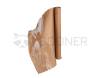
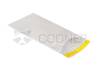
- Bubble bags – Ready-made bags of bubble film, open or with a self-adhesive closure. For recurring sizes there is no need to cut and tape.
Besides film on rolls, we also offer ready-made bubble bags, for example with a self-adhesive closure or in a pink antistatic version, as well as bubble envelopes. Perforated rolls, pre-cut sheets and films with a share of recycled polyethylene are also common in the industry.
Choosing the right film
- Weight and shape of the goods – Small, light items are protected by a small bubble; heavy and angular items by a large bubble or three-layer film.
- Surface sensitivity – For glossy, lacquered and printed surfaces, three-layer film, which is smooth on both sides, or an interleaf of paper is suitable.
- Time in the pack – With long storage or sustained load in a stack, three-layer film or barrier film maintains cushioning for longer.
- Electronics – For parts that are not sensitive to discharge, antistatic film is sufficient. Unprotected boards and components belong in a shielding bag.
- Packing method – The roll width is chosen according to the largest pack; where the size is always the same, ready-made bags save time.
- Sorting by the recipient – If the packaging should end up in a single waste stream, choose film made of pure polyethylene without lamination.
Points to watch
- Bubbles lose air under sustained pressure – This mainly affects films without a barrier and heavy items resting on a small area. Cushioning gradually decreases as a result.
- Bubble imprints – On soft paints and lacquers, especially in warm conditions, bubbles can leave an imprint. Wrap such surfaces in paper first.
- Bubble direction is not a dogma – Carriers‘ recommendations differ: some advise turning the bubbles towards the product, others the smooth side. The number of wraps and the sensitivity of the surface matter more.
- Sharp edges and protrusions cut through the bubbles. Pad them, or choose three-layer film.
- Antistatic film does not shield – It limits the build-up of charge but does not protect against an external electrostatic field. The effectiveness of the additive decreases in dry environments and over time.
- Large voids – The film will fill smaller gaps, but void fill materials are intended for large empty spaces in the box.
Bubble wrap or another material
Air cushions fill the space around goods that are already wrapped, while bubble wrap protects the product itself. In practice the two are combined. PE foam has no bubbles that could deflate, leaves no imprints of them on the surface and can be die-cut into a shaped insert. Where the packaging should be entirely paper-based, bubble wrap is replaced by honeycomb wrap paper or bubble paper (see paper void fill). The empty space is then filled with crumpled paper.
What to send with your enquiry
- What you are packing: dimensions, weight and surface sensitivity
- How it will be used: wrapping, lining the box, interleaving, or bags
- Required type: number of layers, bubble size, antistatic treatment
- Roll width, or the inner dimensions of the bag and the type of closure
- Expected monthly consumption
- Requirements for recycled content or mono-material
Frequently asked questions
What is the difference between two-layer and three-layer film?
Two-layer film has bubbles exposed on one side, while three-layer film encloses them between two flat films. Three-layer film is harder to puncture, smooth on both sides and holds its shape for longer under load. For ordinary lighter goods, two-layer film is sufficient.
Which bubble size should I choose?
A small bubble, about 10 mm in diameter, conforms well to the shape and suits small and light items. A large bubble, about 30 mm in diameter, is taller, suits heavier and bulky items and also evens out irregularities.
Which side of the film should face the product?
There is no single rule. Bubbles facing the product hold it in place better, while the smooth side is gentler on a sensitive surface. For lacquered and glossy surfaces, therefore, choose the smooth side or three-layer film.
Does pink antistatic film protect electronics?
It limits the build-up of charge during packing and handling, but it does not shield against an external discharge. It is intended for parts that are not sensitive to discharge and for work in an ESD protected area (EPA). Unprotected boards and components belong in a shielding bag.
Where does used bubble wrap go?
Clean polyethylene film without labels goes into the yellow plastics container. A paper envelope with a bubble lining can go into paper collection only if the film is separated; otherwise it belongs in mixed waste.