Transport crates and boxes
Crates and boxes are reusable plastic packaging for the transport, storage, and picking of goods. Thanks to their rigid construction and stackability, they save space in the warehouse and during transport, and they last for years of operation, replacing single-use packaging. They are manufactured in standardized dimensions to fit perfectly on pallets and into racking systems.
Which crates and boxes we offer
- Euro crates – stackable crates in standardised sizes (e.g. 600×400 mm) for logistics and production
- KLT boxes – small transport boxes to the automotive standard, ideal for parts, assembly and line supply
- Food crates – a version suitable for food contact, easy to wash and hygienic
- Reuse – a durable, eco-friendly alternative to single-use packaging




Dimensional module
The basic crate size is 600 × 400 mm, i.e. a quarter of a 1200 × 800 mm EUR pallet. The smaller 400 × 300 and 300 × 200 mm modules and the larger 800 × 600 mm module are derived from it, so they can be combined and fill the pallet completely. The size is given as the external footprint; the height varies by design. Stackable small load carrier systems with a useful load of up to 50 kg are described in the EN 13199 standard.
Designs
- Stackable crates – Rigid walls and base; the top rim fits into the base of the crate above. They take up the same volume whether full or empty.
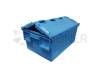
- Nestable attached-lid containers – The lid has two halves that interlock when closed. Full containers are stacked with the lid closed; empty ones nest inside each other with the lid open. They are used in closed loops, for example between a warehouse and branches.
- Folding crates – The walls fold down onto the base. According to manufacturers, folding reduces the volume of an empty crate by 75–84 %, which makes a difference mainly on the return journey.
- Solid or perforated walls – Solid walls and base hold small parts and loose contents. Perforated and grid walls allow ventilation and a view of the contents, and dry faster after washing. Drainage holes in the base let water out when crates are stored outdoors.
KLT boxes
KLT (from the German Kleinladungsträger, i.e. small load carrier) is a container conforming to the VDA 4500 recommendation of the German Association of the Automotive Industry. It is made of polypropylene in 300 × 200, 400 × 300 and 600 × 400 mm modules, with a standard height of 147.5 mm and a high version of 280 mm. The type number indicates the approximate dimensions; 3214, for example, means 300 × 200 × 140 mm.
- R-KLT has a composite (double) base.
- RL-KLT is a lighter version with a smooth base and drainage holes; it weighs less and holds more.
- F-KLT is the folding version.
KLT boxes have a space for a label and are used mainly in closed loops between suppliers and assembly lines.
Material
- Polypropylene (PP) – Stiffer and better at withstanding higher temperatures, such as hot-water washing. Below freezing, however, it becomes brittle and can crack on impact.
- Polyethylene (HDPE) – Remains tough even at sub-zero temperatures, which is why it is chosen for freezer stores.
- Food contact – A crate in which unpackaged food is placed must comply with Regulation (EU) No 10/2011 on plastics in contact with food. The supplier issues a written declaration of compliance for it.
Crates we supply
An attached-lid container measuring 600 × 400 × 250 mm and a perforated 600 × 400 mm crate in heights of 270 and 300 mm. KLT boxes and other sizes and designs are handled according to your requirements.
Choosing a crate
- Contents – Small parts, loose material, food or sensitive products.
- Return journey – Where empty crates are sent back, attached-lid containers and folding crates save space.
- Environment – Washing, freezer store, outdoor storage – these determine the choice between PP and HDPE, and between solid and perforated walls.
- Automotive industry – Automotive suppliers usually use KLT boxes to VDA 4500.
- Identification – A space for a label; crate colour by loop or customer.
Points to watch
- Load and stack height – The maximum useful load and the number of crates in a stack are specified by the manufacturer. An overloaded bottom crate deforms and the stack loses stability.
- PP in freezing conditions – HDPE is the better choice for freezer stores and outdoor use in winter.
- Food – Do not use a crate for direct food contact without a declaration of compliance.
Crates and other packaging
Lighter returnable boxes, inserts and dividers made to measure are produced from corrugated plastic. Corrugated cardboard boxes are the single-use, one-way option. Crates are stacked on pallets and secured there with stretch film.
From 1 January 2030, the PPWR regulation requires companies that transport goods within the EU in plastic crates and foldable boxes, among other formats, to ensure that at least 40 % of this transport packaging is reusable within a re-use system. A stricter requirement applies to transport between a company’s own sites and between companies in the same Member State, although the regulation contains a number of exemptions. Cardboard boxes are exempt from this obligation.
What to send with your enquiry
- External or internal dimensions, or the module (600 × 400, 400 × 300, KLT)
- Design: stackable, attached lid, folding; solid or perforated walls
- Contents and their weight, stack height
- Environment: washing, freezing, outdoor storage, direct food contact
- Quantity and type of loop (closed or open)
- Colour requirements and label space
Frequently asked questions
How many 600 × 400 mm crates fit on a EUR pallet?
Four per layer. For 400 × 300 mm crates it is eight, for 300 × 200 mm sixteen.
What is a KLT?
A small polypropylene load carrier to the VDA 4500 recommendation, the automotive industry standard. Its dimensions match the EUR pallet module, and KLT boxes are used mainly in returnable loops between suppliers and production.
What is the difference between R-KLT and RL-KLT?
The R-KLT has a composite base. The RL-KLT is lighter, has a smooth base with drainage holes and holds more for the same external dimensions.
Are the crates suitable for food?
Only those for which the supplier issues a declaration of compliance under Regulation (EU) No 10/2011. If food is to be placed in the crate unpackaged, please state this in your enquiry.
How much space does a folding crate save?
According to manufacturers, folding reduces the volume of an empty crate by 75–84 %.